Find a Lamp
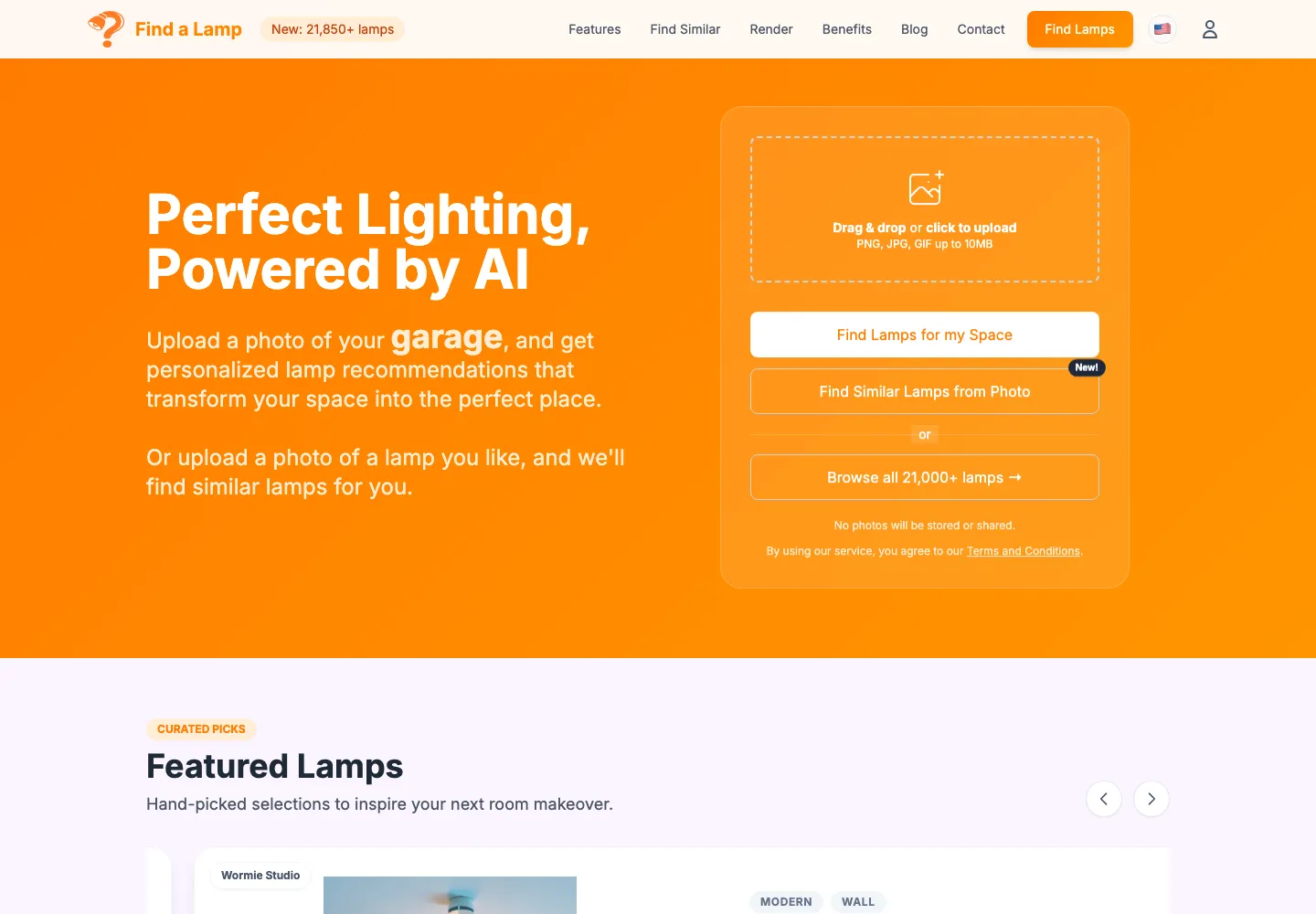
An AI lamp finder — photograph your room, get lighting advice and a shortlist from 21,000 lamps, then render the one you like into the photo before you buy.
- Client
- Internal product
- Year
- 2026
- Status
- Live and public at findalamp.com
- Services
- AI implementation Software & MVPs
- 21,850+
- Lamps in the catalogue
- 3
- AI features in production
- 1
- Person, concept to launch
Find a Lamp is ours. Nobody commissioned it, and it is on this site for a specific reason: it is the whole shape of a product — AI, data, search, accounts, payments, SEO — built and shipped by one person, and running in public where anyone can go and try it.
The problem it solves
Buying a lamp is a badly-served decision. You know the room is wrong and you do not know why, the catalogues are enormous and unsearchable in the ways that matter, and you cannot tell whether a thing will look right until it arrives.
So the product answers the three questions people actually have, in order:
What does this room need? You upload a photo. The AI reads style, colours, layout and the light that is already there, and gives you lighting advice plus a filtered shortlist — not a generic list of best-sellers.
Where do I find one like this? You upload a photo of a lamp you saw somewhere — a magazine, Pinterest, a friend’s flat — and it searches the catalogue visually for the match or the nearest things to it.
Will it look right in my room? It renders the lamp into your own photo, with its light and shadow, before you spend anything.
What made it hard
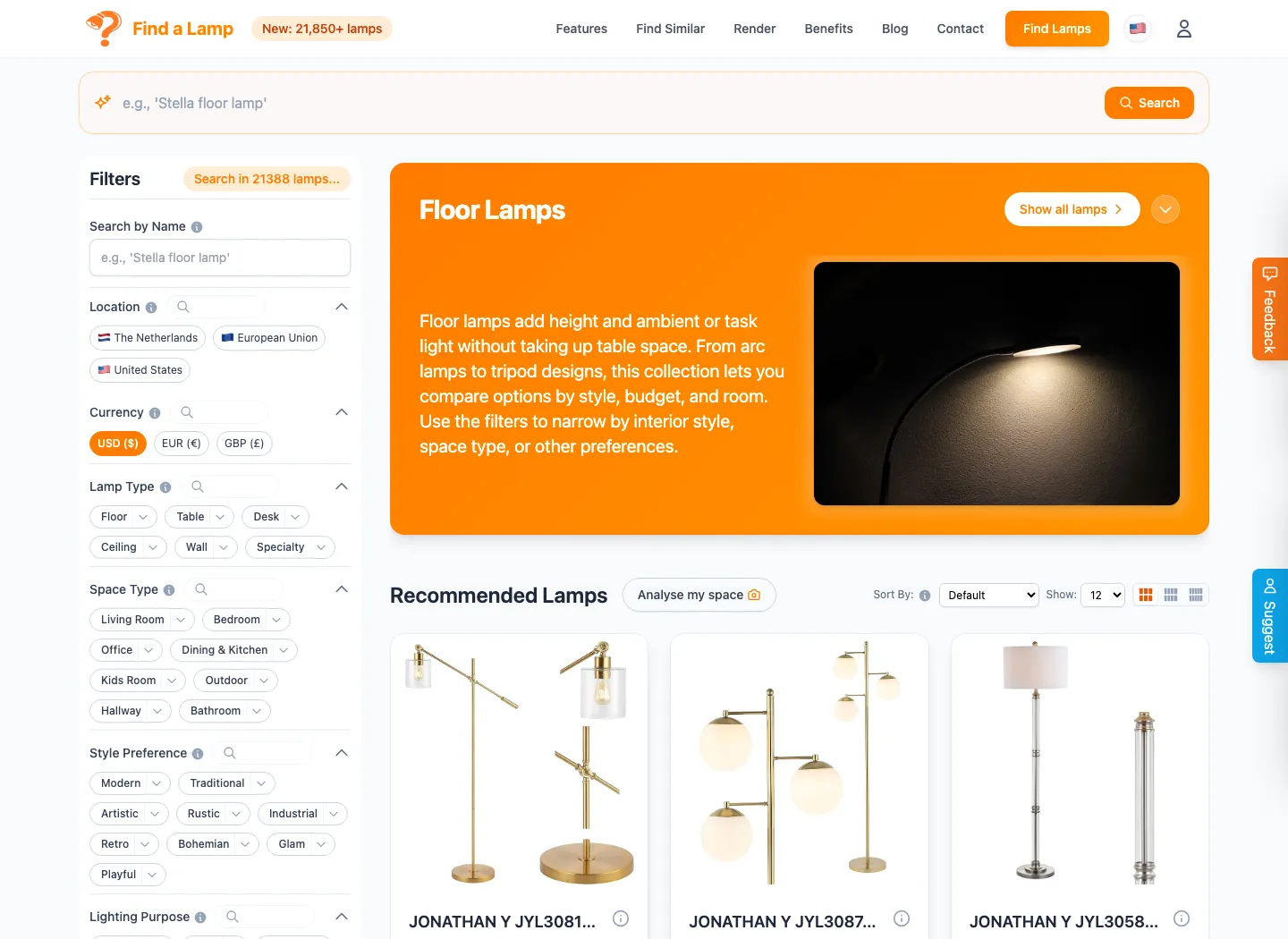
The catalogue is the product. Twenty-one thousand lamps from many retailers, in three currencies and three regions, with prices and stock that move. Ingesting that, normalising it, deduplicating it and keeping it fresh is unglamorous and it is most of the work. The AI is worthless pointed at a stale or dirty catalogue.
Generation has to respect a real photo. Rendering a plausible lamp is easy. Rendering this lamp into that room, at the right scale, throwing light that matches the light already in the frame, is the actual problem — the same constraint problem as Vaib, where the output has to be executable by real hardware rather than merely look right.
It has to be free to try and still pay for itself. Anonymous visitors get the room analysis and the visual search with no account. Rendering is the expensive call, so it is one a month for free users and unlimited on a paid plan, with a professional tier for designers and retailers who want the data out as CSV.
Nobody arrives by accident. A consumer product with no marketing budget lives or dies on search, so the collection pages, the lighting guides and the weekly lighting-news articles are part of the build, not an afterthought.
How it is built
Deliberately lean: a static front end served from the edge, Supabase behind it for accounts and catalogue, and the AI work called per request. No framework ceremony, no infrastructure to babysit, one person able to hold the whole thing in their head and ship a change the same afternoon.
Uploaded photos are not stored or shared. For a product whose front door asks for a picture of the inside of your house, that is a design decision rather than a policy page — the same instinct as the camera-free rule on The Wave and CityGems.
Why it is on the site
Because “we do AI” is worth nothing as a sentence. This is a URL you can open right now, upload a photo of your own living room to, and judge in about forty seconds.
It is also the honest answer to how we scope AI work for clients. Every hard part of this product was a data problem, a constraint problem or a cost problem. The model was the easy bit — which is what we will tell you about your project too.
- AI
- Product
- Computer vision
- Search
- SEO
Knowledge this took
- Applied vision AI on user-supplied photographs
- Image generation constrained to an existing scene
- Visual similarity search across a large product catalogue
- Catalogue data engineering — ingest, normalise, deduplicate, keep fresh
- Faceted search across price, currency, region and style
- Accounts, entitlements and subscription tiers
- Programmatic and editorial SEO
- Shipping a consumer product end to end, alone
So we can also build
- Products where a customer photograph is the main input
- Visual search over a client's own catalogue or archive
- Rendering a product into a customer's own photo before they buy
- Turning a messy supplier feed into a searchable, comparable catalogue
- AI features that have to work for the public, not just in a demo
Something close to this but not quite it?
Got something like this in mind?
Ask Ola how we'd approach it, or go straight to a person.