CityGems
Light modules that clamp onto the lampposts, railings and fences a city already has, and turn a route into a timed run.
- Client
- Sportbedrijf Rotterdam
- Year
- 2025
- Status
- Working modules installed and running in public in Rotterdam; moving toward pilot
- 40 cm
- Bounding cube per module
- 32×16
- LED matrix behind each face
- 0
- Groundwork, foundations or new poles
CityGems is the second installation in LightMoves, our product line of light-driven installations for public space.
The idea
The Wave proved that a camera-free interactive installation survives real, unsupervised public use. CityGems takes that and spreads it across a city.
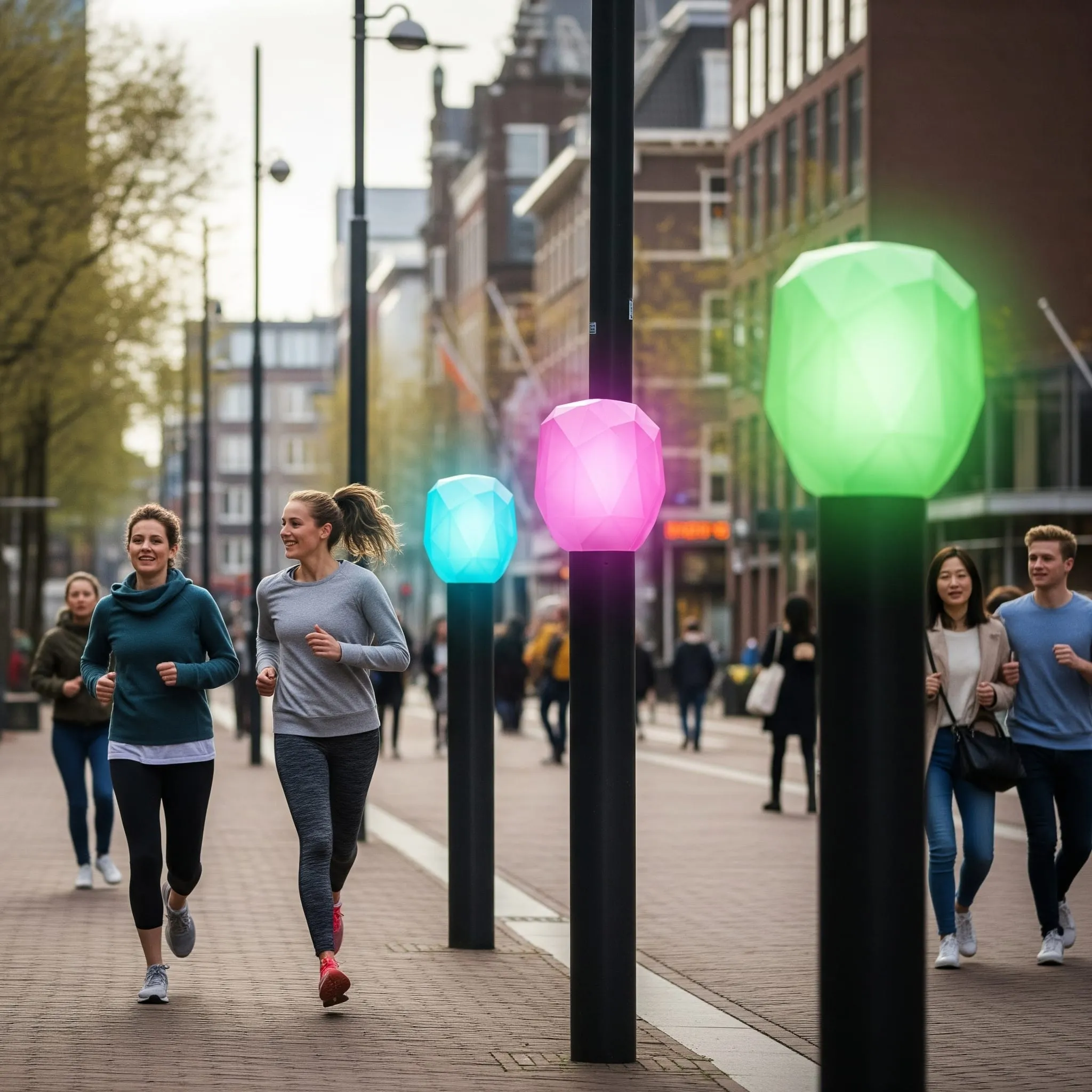
Each module is a faceted, weatherproof unit that clamps onto a lamppost, handrail, bollard or the mesh fence around a sports court. It reacts to movement with light and sound, it talks to the other modules near it, and a companion app ties them together with maps, challenges and progress. The target audience is 12–35 year olds, and the point is to turn overlooked corners of a city into a social, gamified reason to walk, run and explore.
The whole point: it goes on what is already there
Most public-space installations start with groundwork — a foundation, a new pole, a cable trench, a permit for all three, and a bill that is mostly civil engineering before a single light turns on.
CityGems start from the opposite end. Every module clamps onto something the city has already paid for and already maintains. No digging, no concrete, no new street furniture, and nothing that cannot be taken off again without a trace.
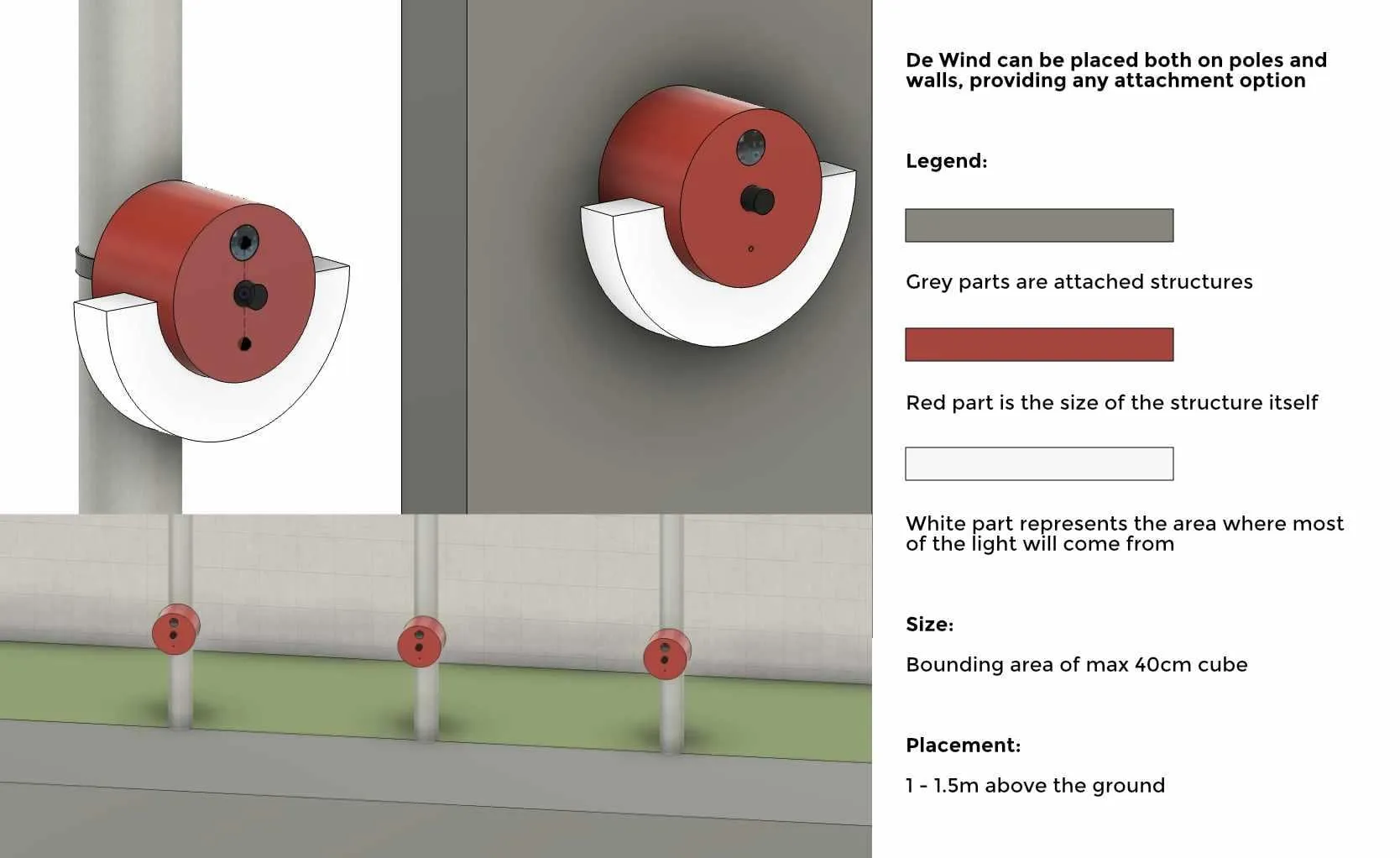
Each unit sits within a 40 cm bounding cube and mounts 1–1.5 m above the ground, which is roughly where a hand goes without anyone having to think about it.
What makes it hard
You do not own the thing you are mounting to. A lamppost belongs to the city, carries its own cabling, and has to stay serviceable. Anything attached has to be non-invasive, safe, and acceptable to the people who maintain the street — which made the clamp design matter as much as the electronics.
Every unit is somewhere inconvenient. One module on a bench is easy. Two hundred across a city means anything requiring a visit — a reset, a battery, a firmware update by cable — does not scale. Each module reports its own status, so maintenance is driven by data rather than by patrol.
It has to read as intentional. A street is visually noisy: bikes, bins, signage, graffiti, greenery. An object that looks like utility hardware either disappears into that clutter or reads as something to vandalise. The faceted shape is doing a job — it catches light in daylight, when the LEDs are off and the thing still has to look like it belongs.
Getting the object right
The form went through physical shape tests before any electronics were involved, working out how a faceted surface catches and scatters light.
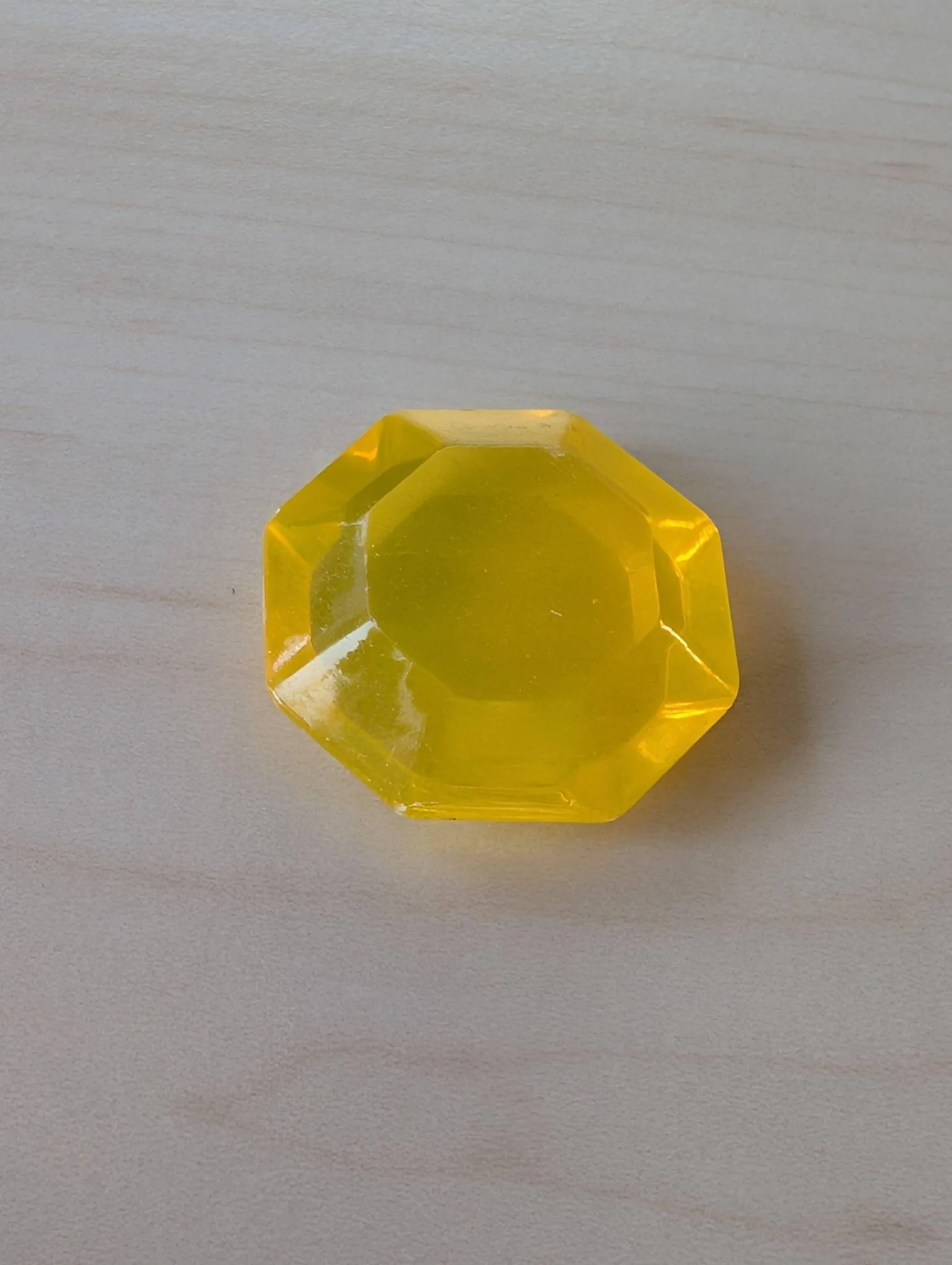
The production diffuser is 3D-printed. That keeps the facets crisp, and it lets the wall thickness vary across the face so the LED matrix behind it reads as even light instead of a grid of dots.
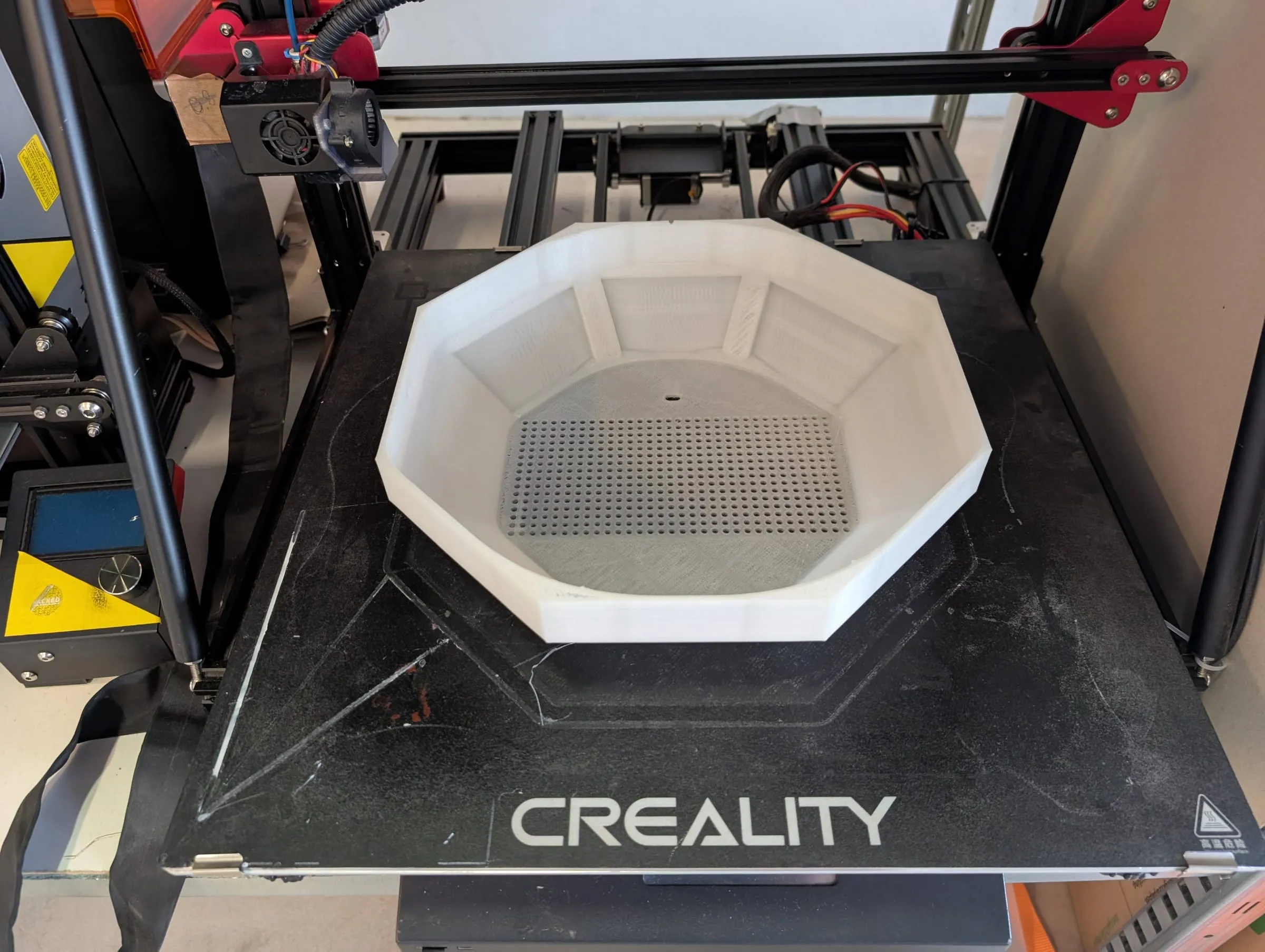
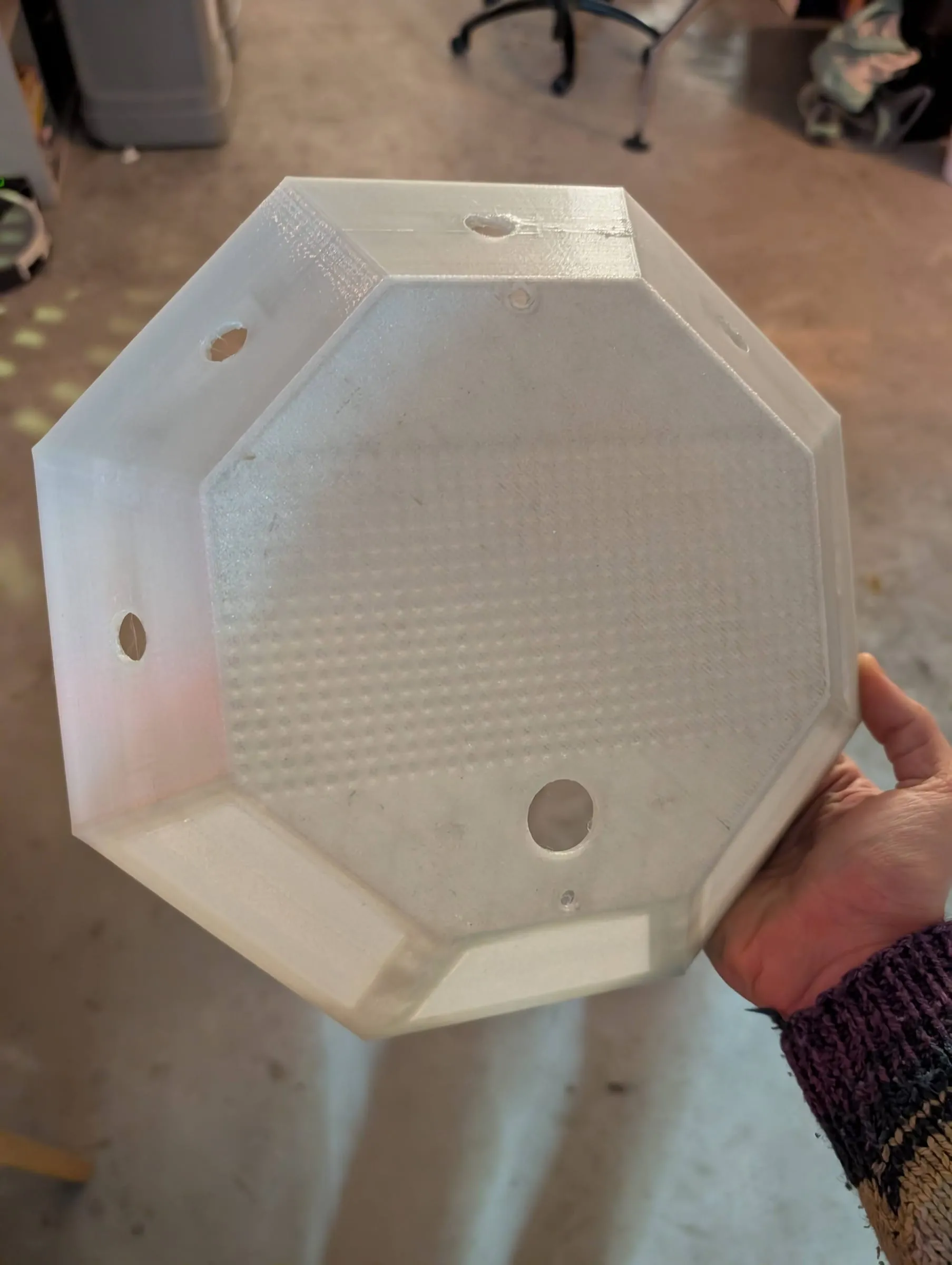
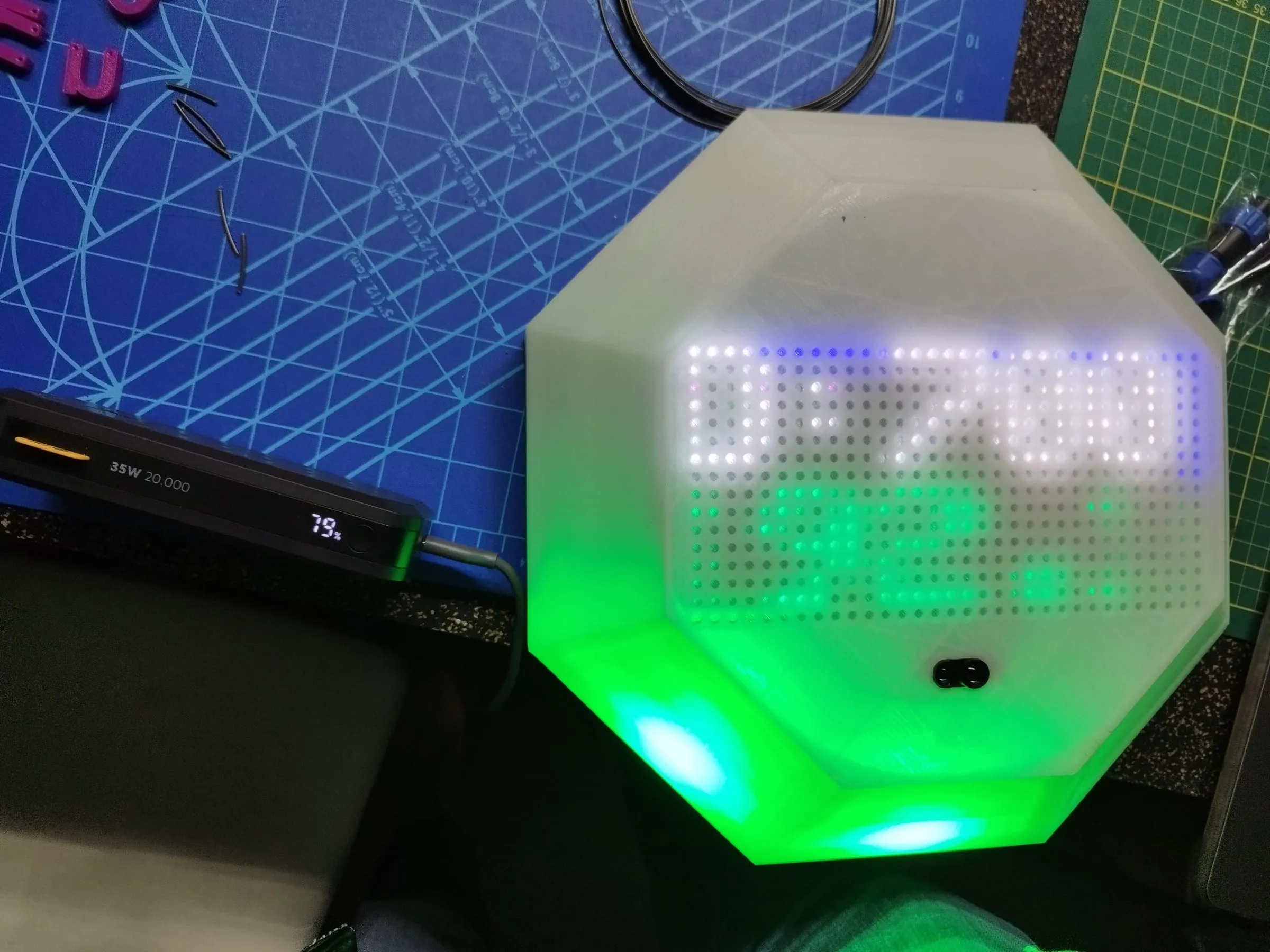
Behind that face is a 32×16 LED matrix, which is enough to show words, numbers
and animation rather than just colour — so the module can say RACE or count
you down without anybody needing a sign to explain it.
Sensing is a time-of-flight distance sensor plus passive motion radar. No cameras, same as everything else we build for public space.
What you do with it
You put a hand near it and it answers immediately. That is the whole interaction — no app to download first, no instructions to read, no account. Everything else is built on top of that one moment working.
Three ways in, printed on the sign next to it:
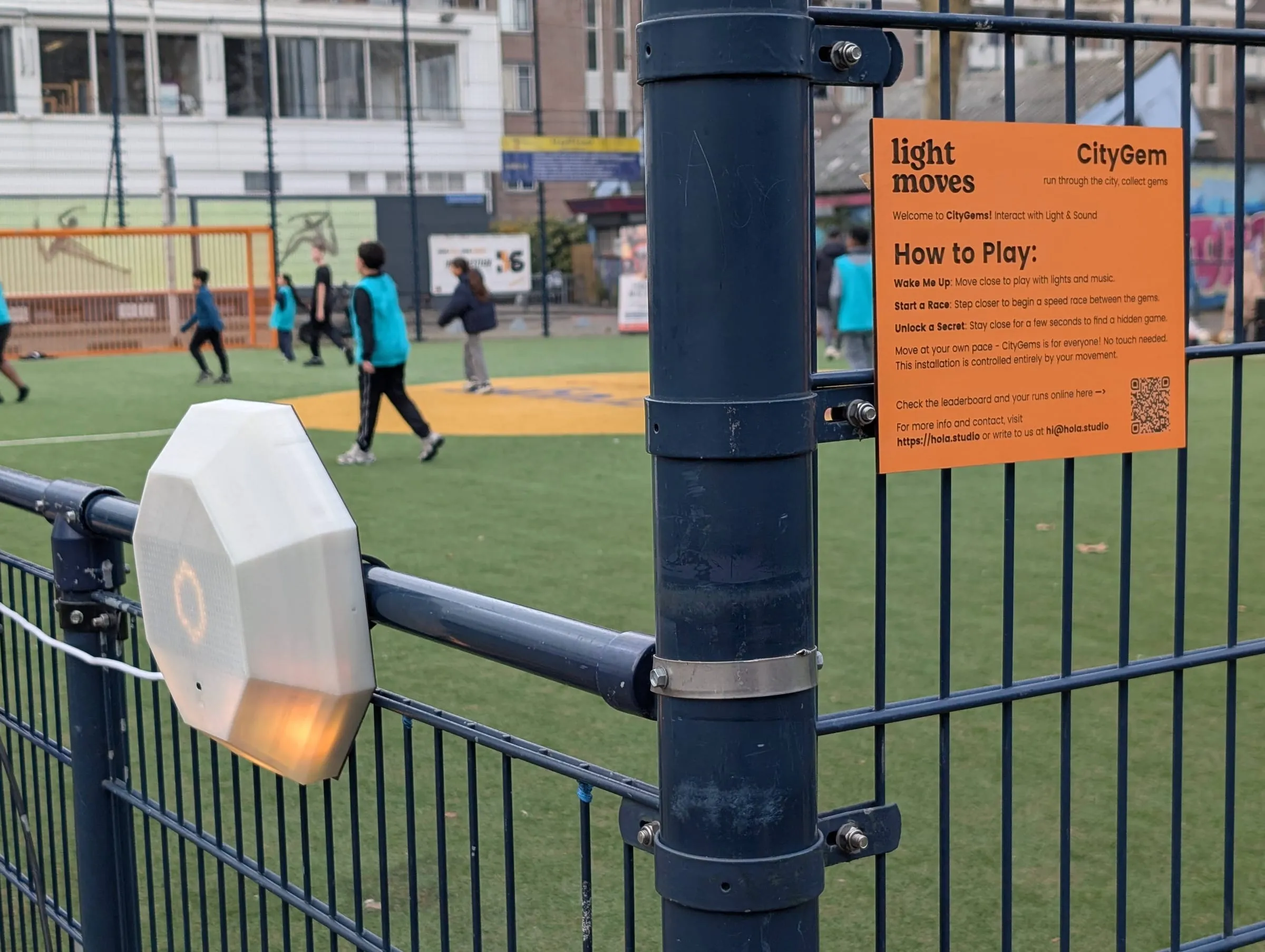
- Wake Me Up — move close, and it plays with light and music
- Start a Race — step closer to begin a speed race between the gems
- Unlock a Secret — stay close for a few seconds to find a hidden game
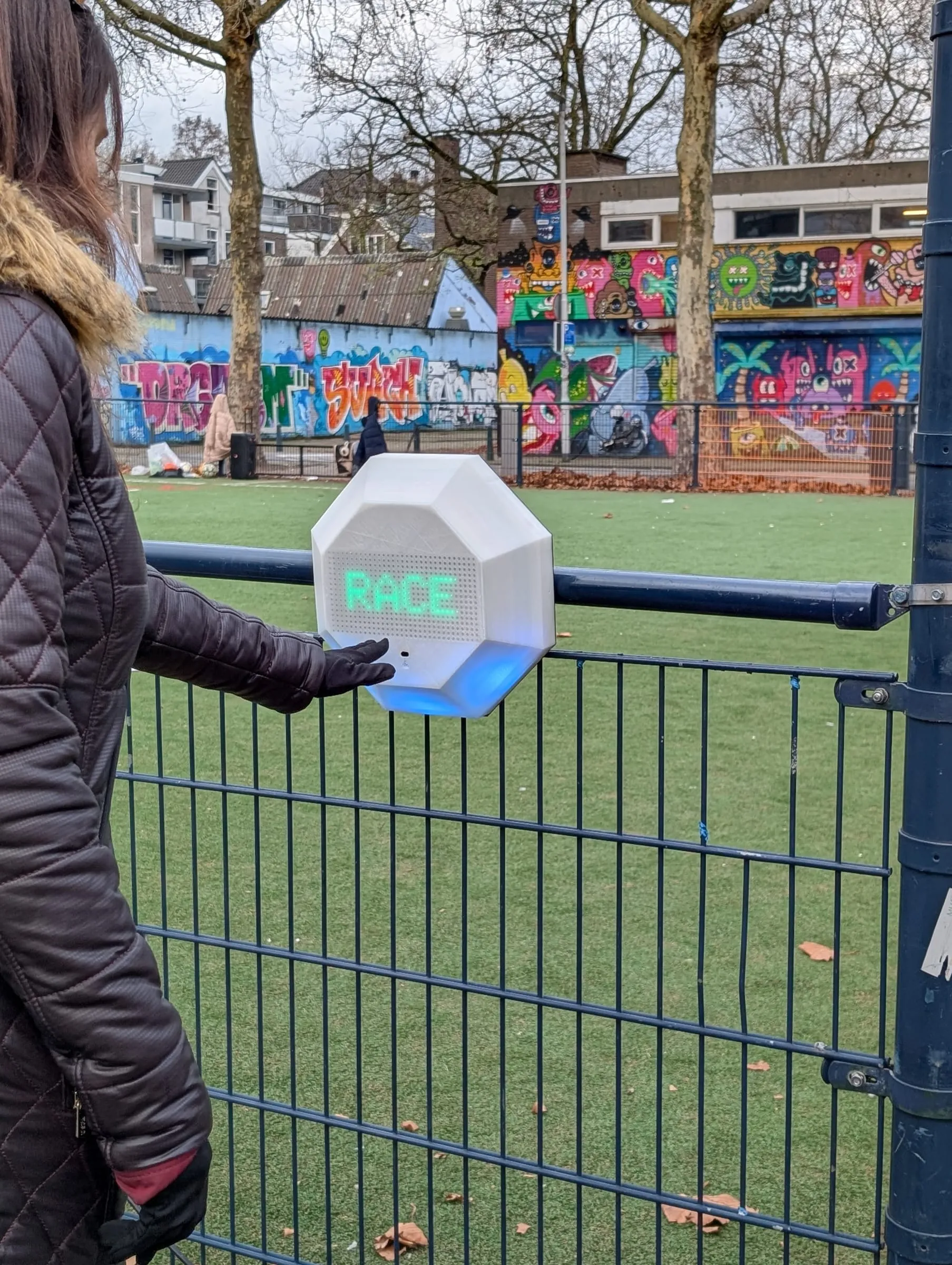
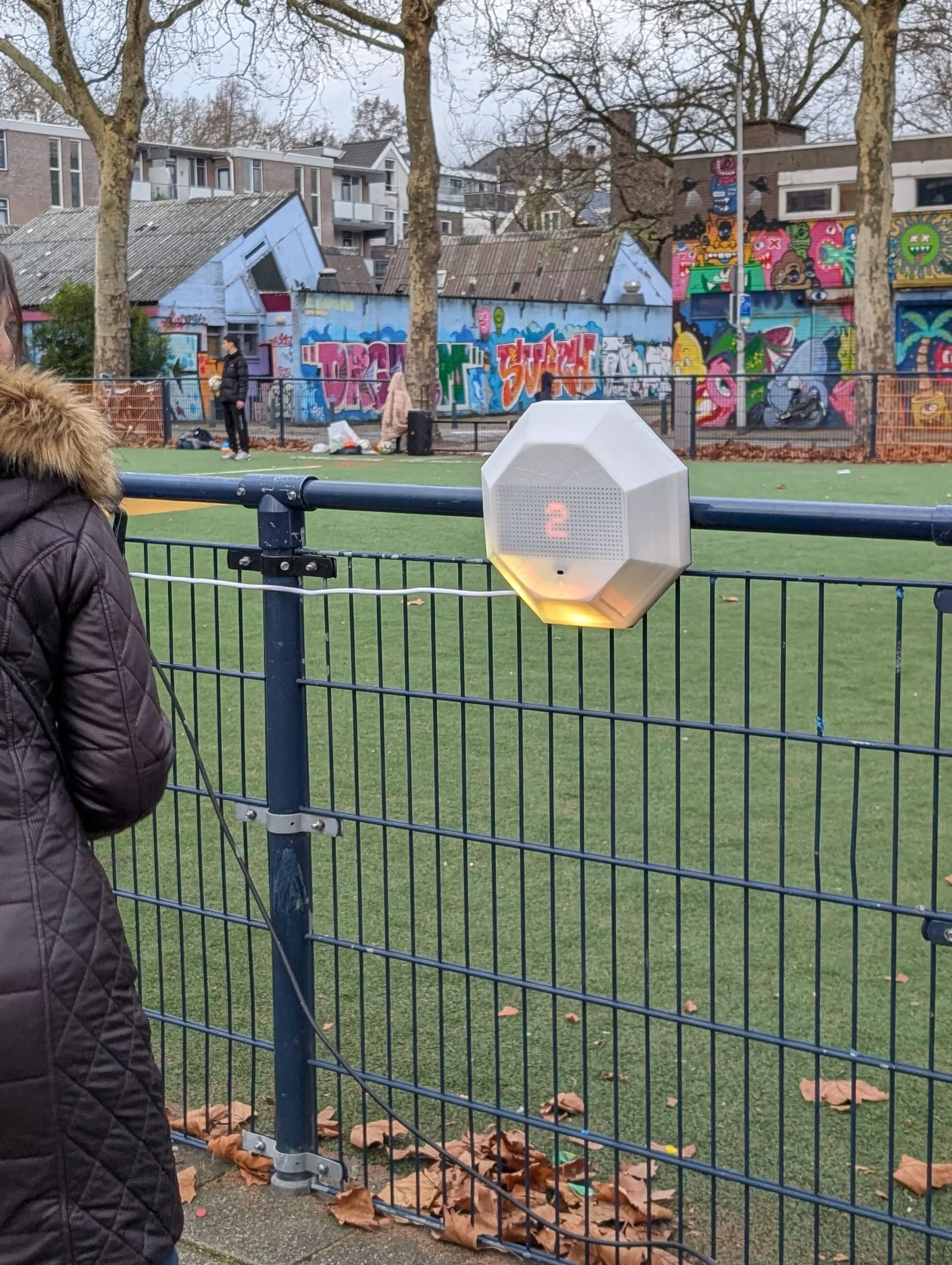
The modules talk to each other over device-to-device radio, which is what turns a line of them along a route into a single timed run with splits at every point — rather than a row of unrelated lights.
On the street
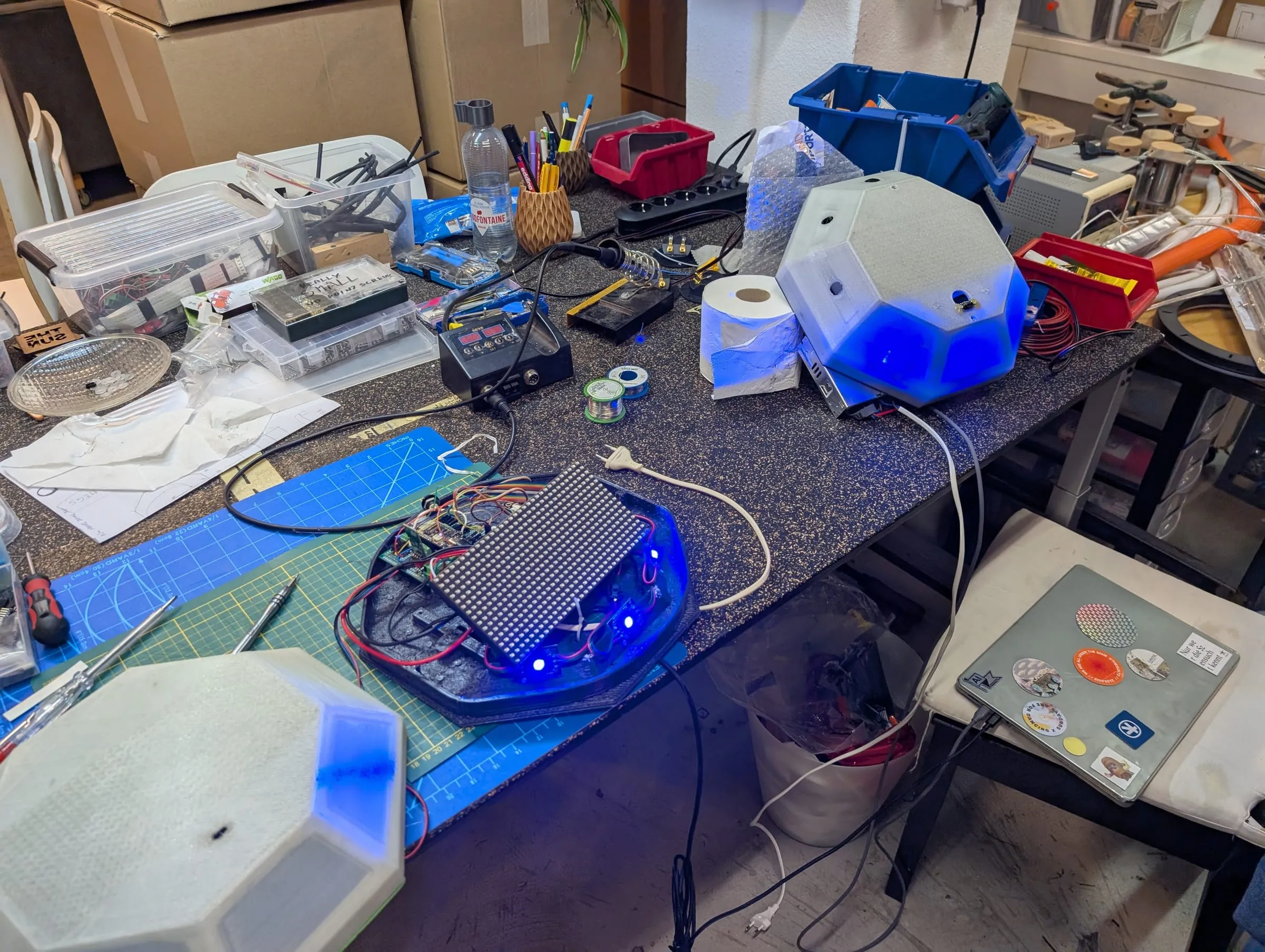
Early enclosures went straight onto Rotterdam lampposts — not to test the electronics, but to see how the thing reads at street scale against real background clutter, and whether the mounting is honestly practical.
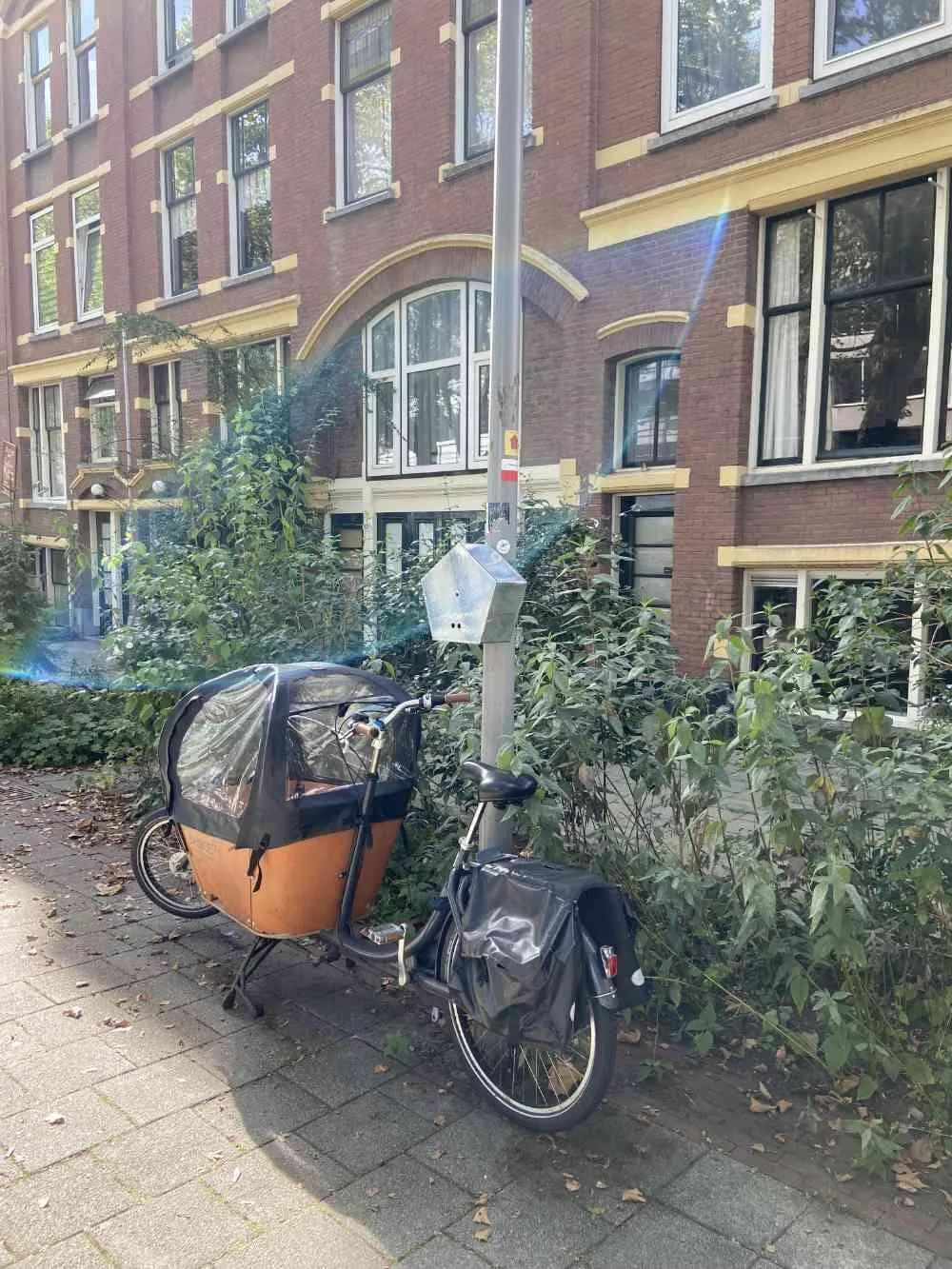
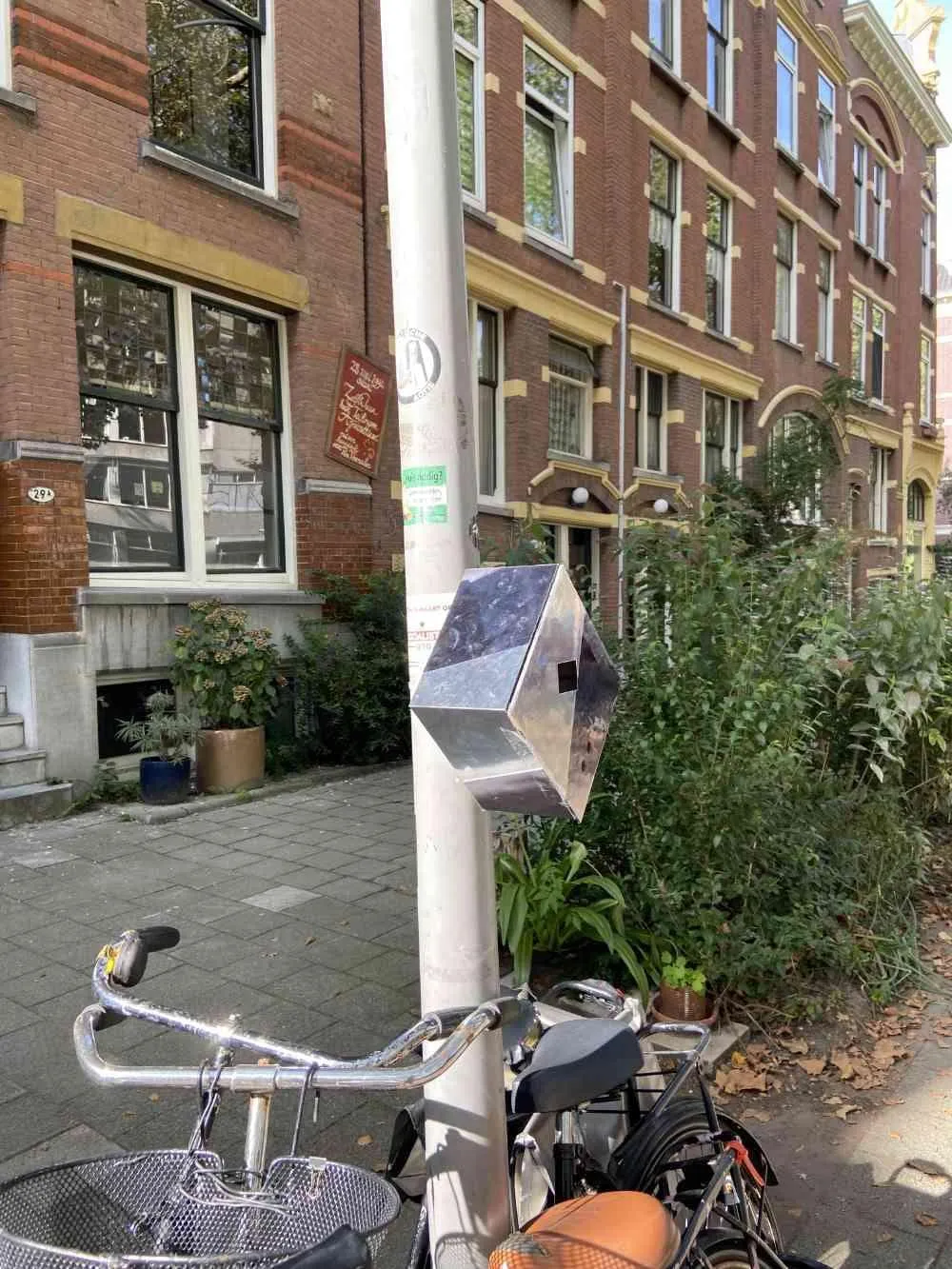
Concept placements along Schuttersveld were used to work out spacing, colour variety, and how the gems hold their own against graffiti and greenery.
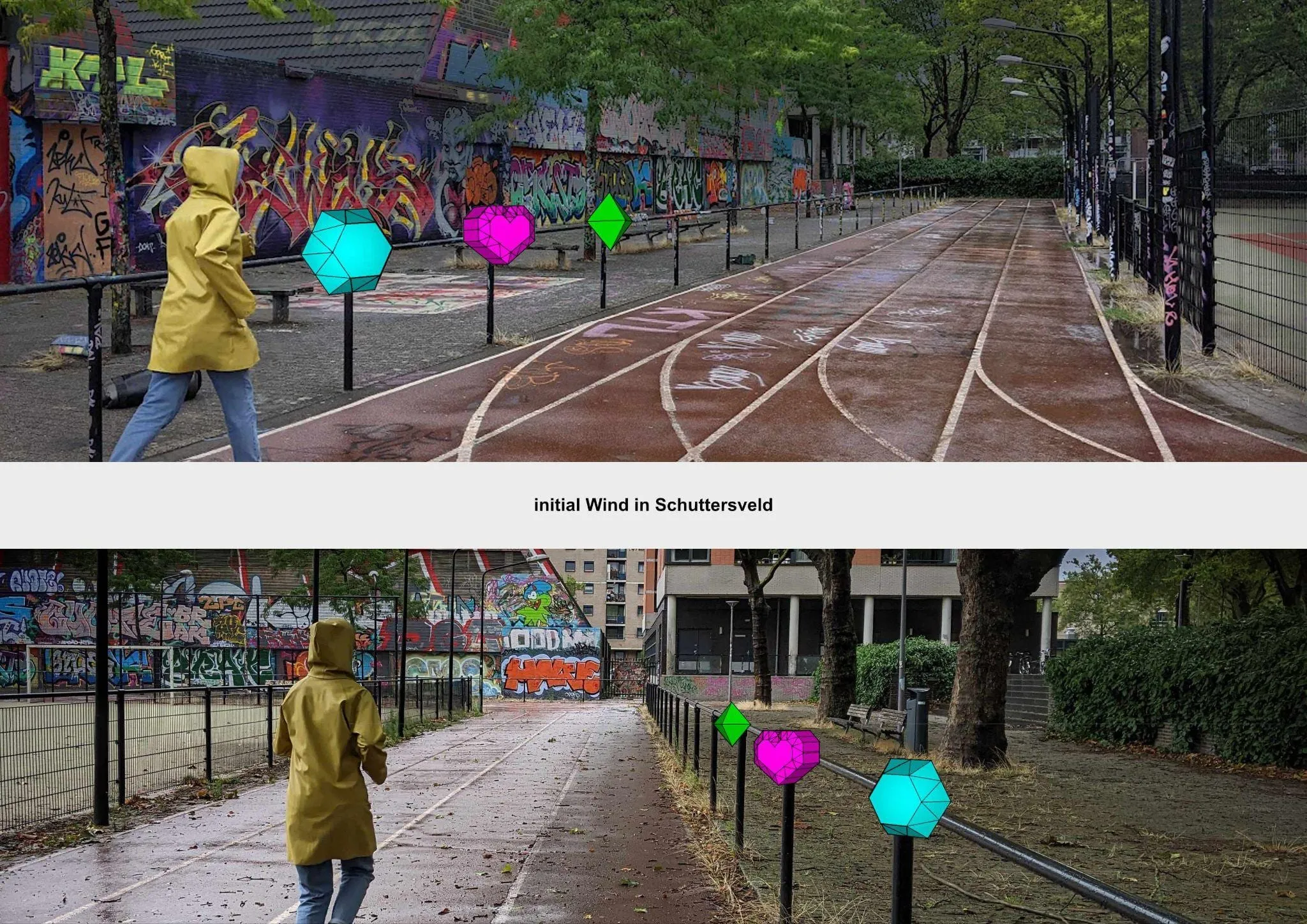
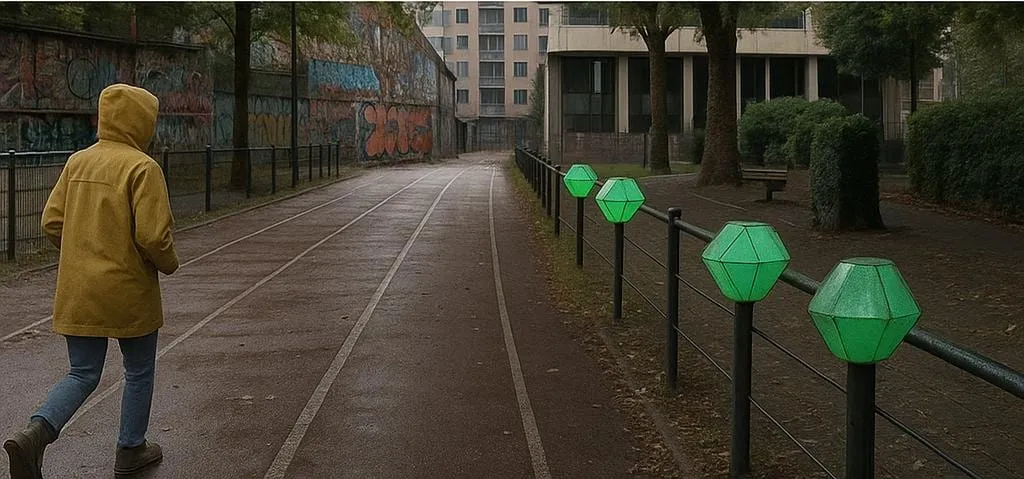
Most of the testing happens after dark, because that is when a light installation does its job. Brightness is measured rather than eyeballed: a module has to be clearly visible from a distance without dazzling anyone walking past, and without adding to light pollution in a residential street — a real constraint for something mounted at eye level.
The interaction itself was prototyped on the bench first, on a dedicated reaction panel, to get the timing and feedback right before committing any of it to an enclosure.
Built with THUAS
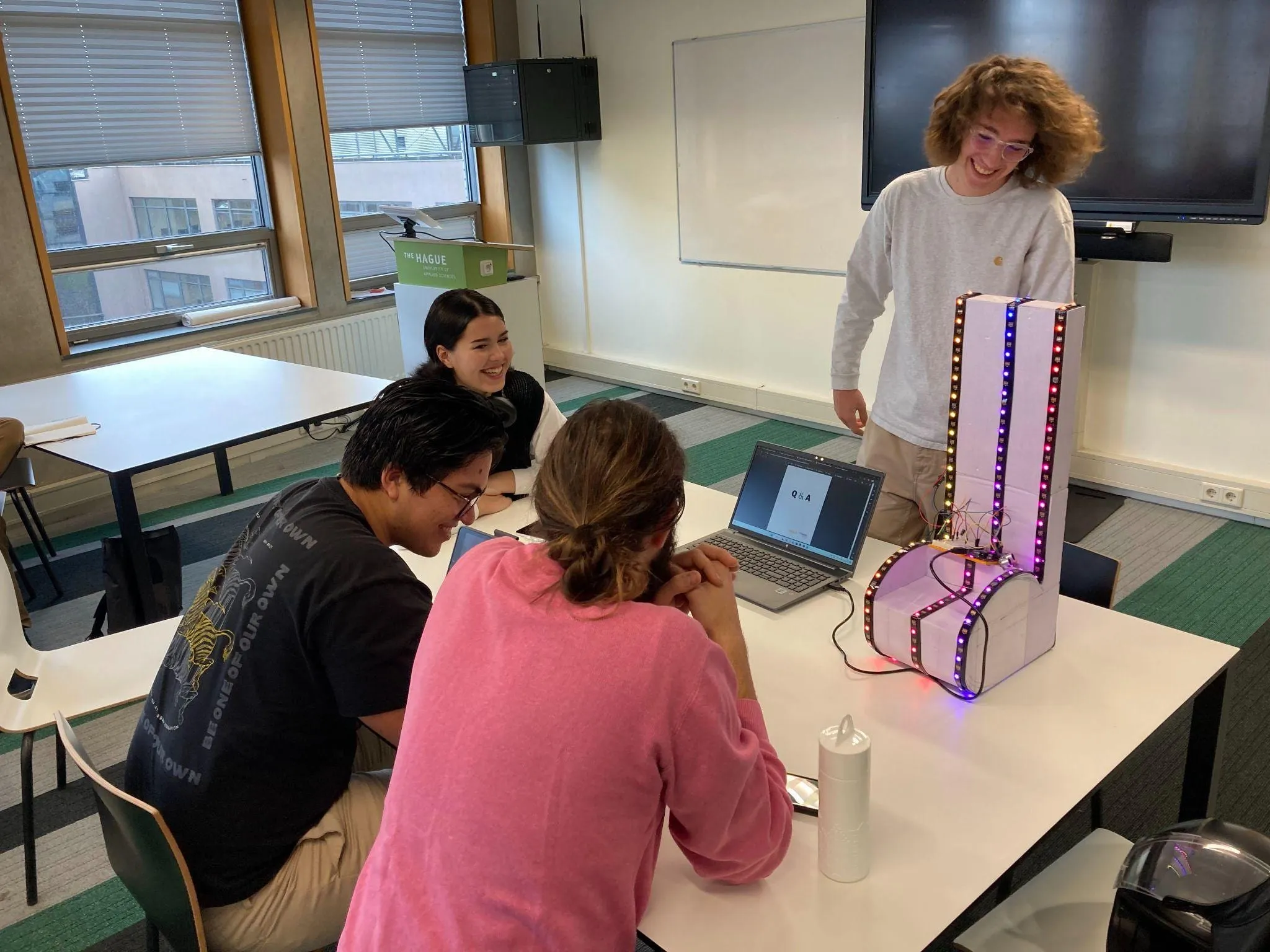
We prototyped the LED and sensor core with The Hague University of Applied Sciences, which gave students hands-on work building the interactive heart of the modules — and gave the project a second set of eyes on the electronics.
Where it stands
Working modules are mounted and running on real street furniture in Rotterdam, with a printed how-to-play sign and an online leaderboard, in front of people who did not know they were coming.
Sportbedrijf Rotterdam has shown strong early interest, and the city’s planners have affirmed the approach of mounting to infrastructure that is already there.
What comes next is a pilot at real scale — a route or a site with enough modules to test the networked behaviour, the timed runs and the fleet reporting, rather than the single-module interaction, which is proven.
- Public installation
- IoT
- Product design
- Urban infrastructure
Knowledge this took
- Weatherproof enclosure design to a fixed bounding volume
- Non-invasive mounting to municipal infrastructure
- Time-of-flight and radar sensing without cameras
- LED matrix driving and optical diffuser design
- Device-to-device radio between units in the field
- Fleet self-reporting and remote status monitoring
- Measuring brightness against light-pollution limits
- Companion app design — maps, challenges, progress
- Working within city planning and public-space constraints
So we can also build
- Networks of connected devices installed across public space
- Retrofit hardware that attaches to infrastructure you do not own
- Gamified engagement tied to physical locations
- Anything that has to be maintained at scale without visiting each unit
- Outdoor displays that stay legible in daylight and after dark
Something close to this but not quite it?
Got something like this in mind?
Ask Ola how we'd approach it, or go straight to a person.